

Regenerative Therapies
Exosomes + PDGF
Cellular-Level Science
Regenerative therapies represent the frontier of aesthetic medicine — moving beyond treating symptoms to directing how your cells heal, rebuild, and renew. At Ovation, we offer two complementary regenerative technologies: exosome therapy and PDGF (Platelet-Derived Growth Factor). Exosomes are cell-derived signaling vesicles that deliver a comprehensive payload — growth factors, anti-inflammatory cytokines, and regulatory microRNA — to modulate the entire healing response. PDGF is a concentrated growth factor that powerfully stimulates fibroblast recruitment and collagen production. Each excels in different contexts, and your Ovation provider selects the optimal regenerative therapy based on your treatment protocol and goals. We strongly recommend regenerative enhancement with Halo and Tixel treatments, where the combination of micro-channel delivery plus regenerative signaling produces results that neither technology achieves independently.
Regenerative therapies enhance virtually every treatment in Ovation's skin health platform. They're the biological amplifiers that improve healing quality, accelerate recovery, and produce more uniform results — transforming good treatments into exceptional outcomes. Patients from Tanglewood, River Oaks, and the Energy Corridor seek regenerative therapies at Ovation's Galleria-area clinic on Woodway Drive.
Explore all Skin Health options →Two Regenerative Approaches, Precision Selection
Exosomes and PDGF work through different mechanisms and excel in different contexts. Understanding the distinction ensures you receive the optimal regenerative support for your treatment.
- Growth factors (EGF, FGF, VEGF) stimulate fibroblast collagen synthesis
- Anti-inflammatory cytokines moderate redness and reduce PIH risk
- Regulatory microRNA guides melanocyte behavior for even pigmentation
- Preferred enhancement for Halo resurfacing and Tixel delivery
- Potent fibroblast recruitment to treatment sites
- Stimulates collagen and elastin production directly
- Amplifies extracellular matrix formation for tissue density
- Preferred for scar revision, deep collagen induction, wound healing
Treatment Advantages
The Treatment Experience and Procedure Details
As Treatment Enhancement (With Halo, Tixel, or Microneedling)
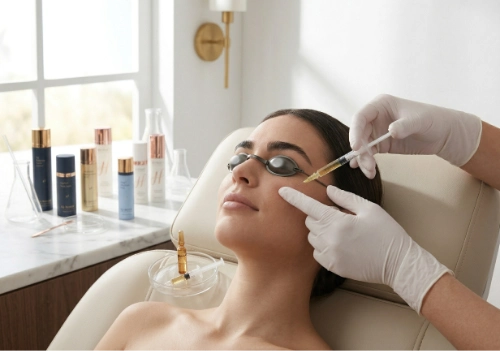
Regenerative therapy is applied immediately following your primary treatment — Halo, Tixel, microneedling, or other micro-channel-creating procedure. Your provider applies exosome solution or PDGF to the freshly treated skin while channels remain open. The active molecules penetrate 10-20x deeper through these channels than on intact skin. Application takes 5-10 minutes and is painless. In some protocols, a second application may be recommended 24-48 hours later.
No additional downtime is added. Your recovery timeline follows the primary treatment (e.g., 3-5 days for Halo, 2-5 days for Tixel). Many clients report faster resolution of redness and smoother healing progression when regenerative enhancement is included.
As Standalone Exosome Facial
The standalone exosome facial delivers regenerative signaling through professional application techniques — no needles, no lasers, no downtime. Your provider cleanses and preps the skin, applies exosome concentrate, and uses professional massage and delivery techniques to maximize penetration. Session takes 30-45 minutes. Walk out with immediately hydrated, luminous skin. Zero recovery needed.
Standalone exosome facials are ideal for clients wanting regenerative benefits without treatment-level intensity, as pre-event skin preparation, or as monthly maintenance between more intensive sessions.
Choosing Between Exosomes and PDGF
Your provider will recommend the optimal regenerative therapy based on your treatment context. General guidance: Exosomes are preferred with Halo (broad healing support + melanocyte regulation for pigment correction), Tixel (comprehensive delivery through uniform channels), and when anti-inflammatory support is important. PDGF is preferred with microneedling for scar revision, deep collagen induction treatments, and when maximum fibroblast stimulation is the primary goal. Your provider may recommend both in sequence for complex protocols.
Best Candidates
- Clients receiving Halo resurfacing (exosome enhancement)
- Clients receiving Tixel treatments (exosome delivery)
- Microneedling for scar revision (PDGF enhancement)
- Clients seeking standalone regenerative facial
- Post-procedure healing optimization
- Pigmentation concerns (exosome melanocyte regulation)
- Scar improvement (PDGF fibroblast stimulation)
- Clients wanting cellular-level anti-aging maintenance
Frequently Asked Questions
What are exosomes?+
What is PDGF therapy?+
How do exosomes and PDGF differ?+
When would exosomes be recommended vs. PDGF?+
Can I use regenerative therapies as standalone treatments?+
Are regenerative therapies safe?+
Related Treatments


Better Signals. Better Healing. Better Results.
Exosome and PDGF regenerative therapies — the biological amplifiers that transform good treatments into exceptional outcomes. Schedule at our Woodway Drive office in Houston's Galleria area.